Rediscovering education through a Master of Education
After 15 years in the classroom, Kate Parker-Corney realised she needed a new way of looking at her practice. Educational theory had evolved significantly since her initial teacher education, and she had developed a deep interest in literacy instruction, an area of growing interest across schools.
“It was time for a refresher,” Kate says.
“To step back and ask: what do we understand now that we didn’t when I started and what does that mean for my classroom?”
Kate’s teaching career began after completing a Bachelor of Arts majoring in English and Media Studies, followed by a Postgraduate Diploma in Secondary Teaching at Te Kunenga ki Pūrehuroa Massey University. Since 2009, Kate has taught at Queen Elizabeth College in Palmerston North, where she is now Head of Social Sciences.
When Kate began considering a Master of Education (MEd), the professional inquiry pathway appealed most because she expected to study part-time and wanted a manageable balance alongside full-time teaching.
Returning to study after 15 years was daunting. Concerned she might be rusty, Kate eased in with a 100-level Critical Thinking course, a step she describes as a fantastic reintroduction to study. When it came to course selection, she initially agonised over whether she needed a specialisation. A Massey postgraduate advisor assured her she didn’t, freeing her to choose papers based simply on interest and relevance. She selected courses in literacy education, digital education, motivation and learning. Balancing postgraduate study with work and family required intention. Kate made a list of all her commitments, ringfenced the non-negotiables (whānau and teaching) and made tough decisions about what she could step back from temporarily.
Her workload shifted dramatically when she received a TeachNZ study award, allowing her to study full-time for a year. Having already completed two courses part-time, she finished the remaining four courses in that year.
“It was intense, but manageable,” Kate admits.
Her professional inquiry explored what influences secondary teachers’ self-efficacy in literacy instruction, a topic rooted in her long-standing involvement with disciplinary literacy. One challenge was navigating the quantitative methodology she had chosen despite having no background in statistics. Her colleagues in the maths department stepped in, answering countless questions.
“I kept asking until I had enough of an understanding to get by,” Kate laughs.
The deeper impact of the Master of Education, however, went beyond individual courses or research choices. Kate says her thinking about education has completely changed. She now sees more clearly the theoretical frameworks underpinning practice, allowing her to make meaningful connections between research, policy and the relational nature of teaching.
“Education is a weird kind of space,” she explains.
“It’s both very theoretically driven and deeply personal. Now I have a framework for understanding how those things can coexist effectively.”
Kate’s learning was immediately translated into practice. After exploring digital archives in one course, she transformed the way she introduced primary sources to learners across year levels, scaffolding source analysis earlier and more intentionally. The result was a cohort of learners arriving in senior history not only better prepared but genuinely excited about engaging with historical sources.
Kate says completing the Master of Education has made her a better teacher.
“I’m more strategic with data, more deliberate in evaluating what works, and better equipped to understand why something doesn’t. Completing the MEd also opened new doors.”
As a result of her studies and connections she made, Kate was invited to be part of a Massey University Research Fund (MURF) investigating the use of Generative AI to improve learner criticality.
“This has been a real growth process working with really experienced researchers and trying to absorb as much as I could in the time we’ve had together.”
Encouraged by others, Kate applied to doctoral study. Her PhD candidacy has been confirmed and she is now back to full-time work while studying part-time.
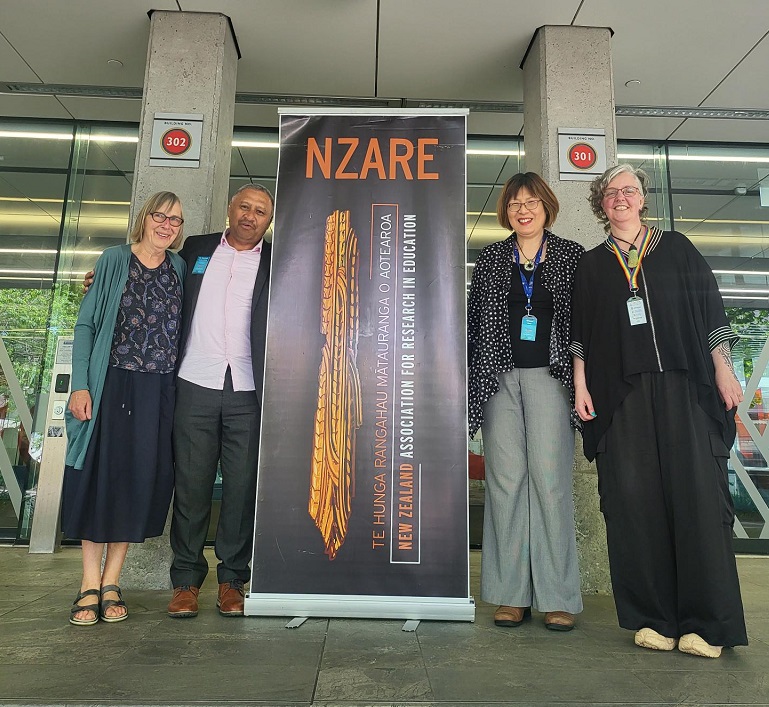
From L to R: Dr Bronwen Cowie, Dr Te Hurinui Karaka Clarke, Dr Elaine Khoo, and Kate Parker-Corney, representing our wider research team at NZARE 2025 for our symposium
Fostering Learner Criticality with Generative AI in Social Sciences Classrooms.
“The academic bug bit hard! I have a contribution to make to the field of education and I’m determined to make it.”
The most rewarding part of the journey came from the ripple effect she never expected. Friends, family, students even colleagues watched her push through challenges, frustration and perseverance.
Seeing their growing belief that they, too, could pursue tertiary or postgraduate study meant more to her than grades or milestones.
“Mā mua ka kite a muri, mā muri ka ora a mua,” she reflects.Those who lead give sight to those who follow, and those who follow give life to those who lead.
Kate says the biggest change in herself is connection. Teaching, especially in a small department, can feel isolating but with her MEd, her world of networks opened up.
“Because of this study, I feel connected - to an institution, to other teachers, to ideas, to research. That’s the biggest change.”