 Craig's first car on shingle back of Massey on Turitea road
A culture of progress: building success through continuous improvement
In a high school chemistry class in Hawke’s Bay, Craig Hickson’s future arrived as a surprise announcement. A careers advisor walked in with news of a study grant from Hawke’s Bay Farmers’ Meat Company for a degree Craig had never heard of: Food Technology.
At the time, Craig was already pre-enrolled at Massey University for a Bachelor of Science, still figuring out what he wanted to major in. But when he looked up what Food Technology involved, something clicked. “I liked the idea that it was applied science, rather than pure,” he recalls. That practical, hands-on approach suited him, and the grant sealed the path. It came with a guaranteed holiday job at the meat plant, plus a modest stipend that mattered more than it might sound today.
Craig laughs that the grant was “some magnificent sum of $300 a year,” but paired with heavily subsidised fees back then, it made study possible and purposeful. That grant didn’t just change his degree. It introduced him to an industry that would become his life’s work.
Massey years: applied science, rugby, and a broken jaw that changed everything
Craig studied at Massey from 1970 to 1973, graduating in 1974. His time on campus was busy, shaped by the rhythm of lectures and rugby seasons and the realities of student life.
“I was keen on rugby, a keen rugby player,” he says. In those days, without the same style of interim assessments, Craig admits the academic year had a different cadence: you could “play around a bit in the first half of the year and knuckle down at the back half to pass your subjects.” Winter meant rugby; when rugby finished, it was time to study for finals; then home for summer work.
And it was rugby that led him to someone who would become central to his story. In his third year, Craig suffered a broken jaw. He ended up in hospital, and that’s where he met Penny, a nurse on the ward. The recovery was memorable in its own way: “I had a memory of five weeks of egg nogs and soup,” he says, describing how everything had to be strained so he could drink through a straw. One lecturer even joked that he preferred Craig with his teeth wired together “because I was quiet.”
Craig and Penny didn’t start dating straight away, but fate kept circling back. “It was a bit over a year later. I plucked up the courage to ask her out,” he says. They married the year after he finished university, and together, they would take on risks most people would never consider.
An apprenticeship in the industry and a national view from Wellington
Craig’s Food Technology training didn’t stay in the classroom. During his degree, most holidays were spent working in the meat plant: moving through departments, learning the practical realities of processing and operations. He also had a short stint in Australia at a Campbell’s Soup factory in Shepparton, north of Melbourne, but otherwise, the meat plant was his training ground.
After graduating, he took a management cadet role at the Hawke’s Bay plant as assistant to the works manager, doing project work for about 18 months. Then came a pivotal shift: he was “shoulder tapped” for a product development role at the New Zealand Meat Producers Board in Wellington, supporting a joint venture project to develop vacuum skin-packaged lamb cuts for North America.
That move broadened his perspective from local operations to a national industry. “Joining the Meat Producers Board gave me a national perspective,” he says. Through that role, he visited most meat plants around the country and gained an appreciation for the sheer scale and economic importance of New Zealand’s meat sector.
Looking back, Craig describes the 1970s as his apprenticeship: spanning university, plant work, management training, and the Meat Board years. The Board also supported him in continuing his studies. He studied at Victoria University, completing papers in Economics and Marketing. That mix became a defining strength: “I developed quite a breadth of knowledge, enough to be dangerous and not a specialist,” he says with a grin, but strong enough to test what he was being told, which he calls “a very important thing in decision making.”
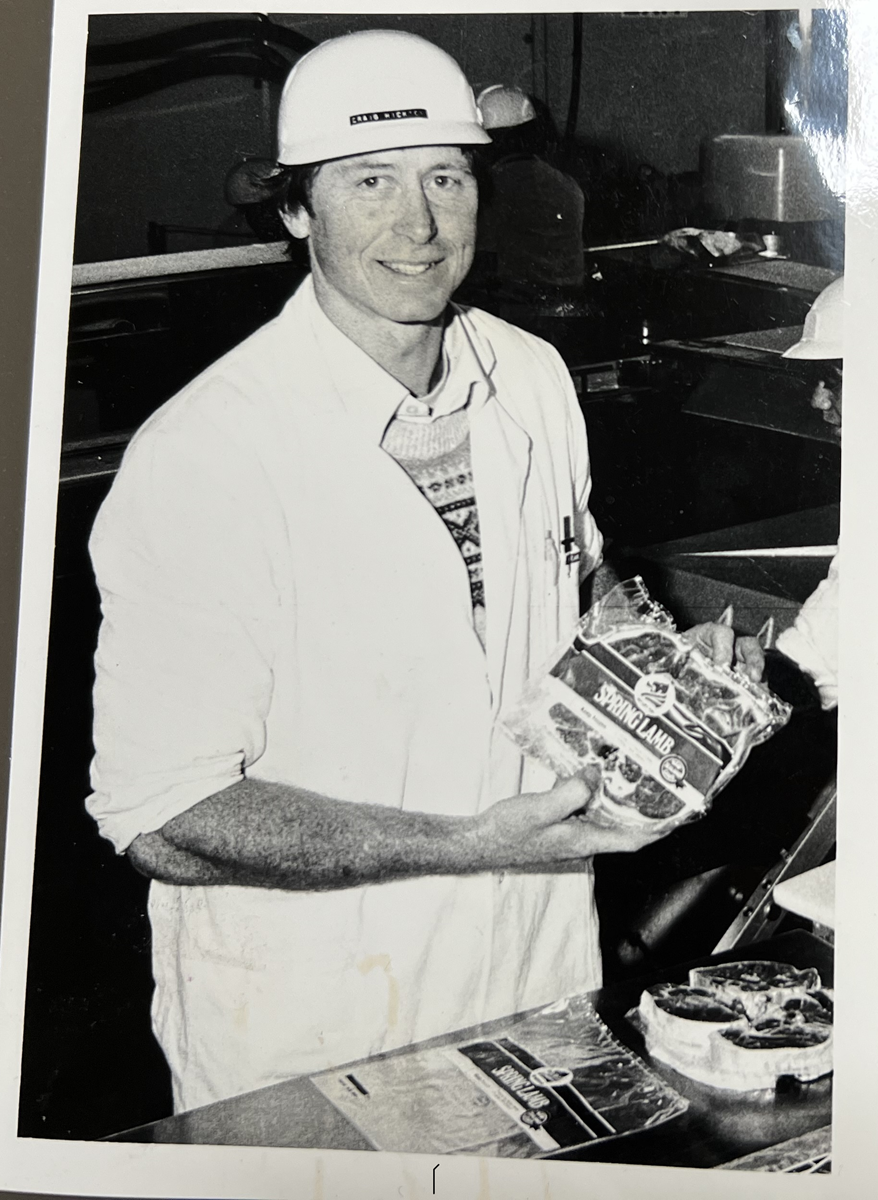 In boning room approx. 1982
Selling the family home to bet on a business
In the late 1970s, Craig felt the pull to build something of his own. He’d always had it in the back of his mind, and eventually he found what he believed was the right opportunity: a cold-store development in Hawke’s Bay, where he could create a small processing annexe and offer contract service processing for export.
To do it, he made a decision that still sounds bold decades later: he sold the family home in Wellington and moved back to Hastings with Penny and their two young children.
“It put everything on the line,” he says. His business model matched his circumstances: he couldn’t afford land, couldn’t afford a building, and couldn’t afford to own a product. What he could afford was “enough to get some rudimentary equipment,” set up a processing room, and begin as a contract service provider.
Then, on Christmas Eve, everything collapsed. The cold store company announced they were no longer coming to Hawke’s Bay. Craig had moved, resigned his job, and suddenly had no platform for the business he’d planned. A second option fell through too and when the local meat co-op offered to hire him to manage their plans, Craig turned it down. “I just left the job of being an employee, and I didn’t want to go back to be an employee,” he says simply.
So, on New Year’s Day 1981, Craig knocked on the door of John Thompson at Richmond Cool Stores in Hastings.
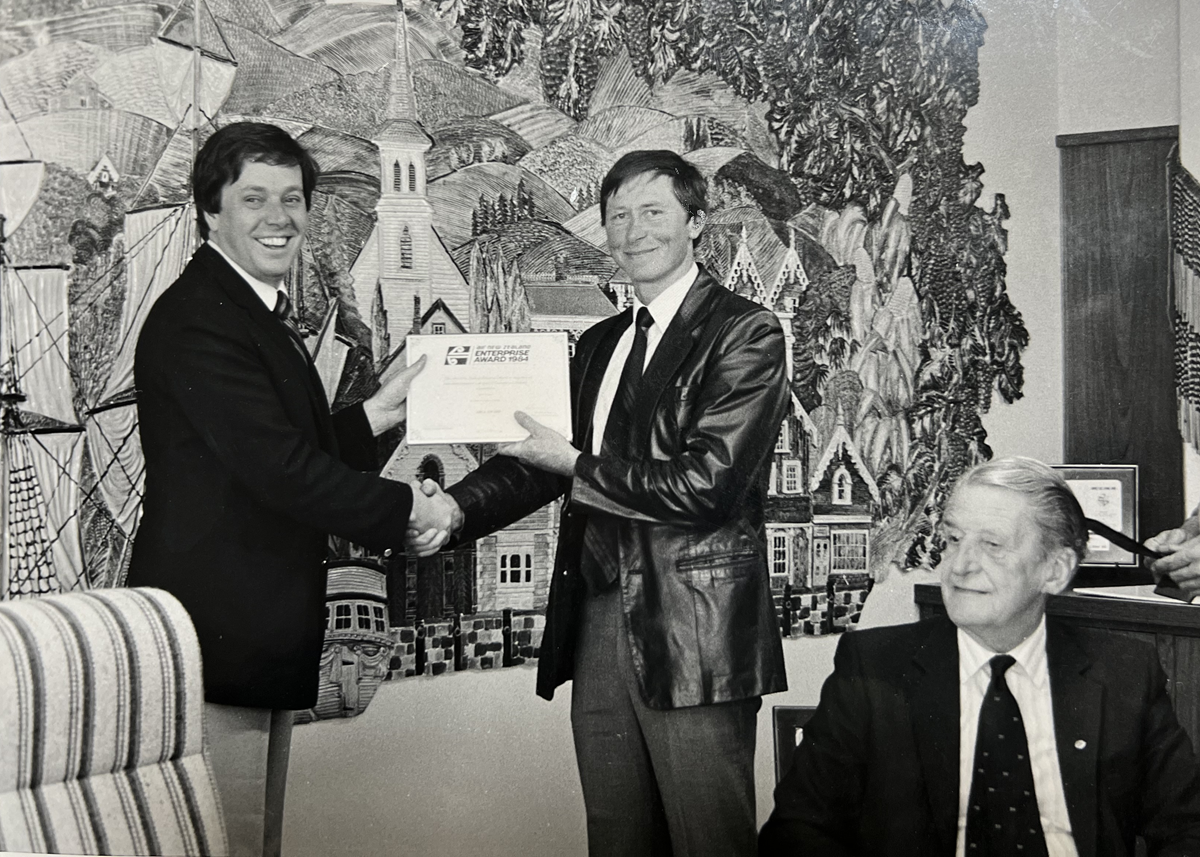 Receiving enterprise award in 1984 from MP David Butcher
The birth of Progressive Meats and a rent bill that “couldn’t fail”
John took Craig for a drive, showed him a newly built cold store and pointed out a section next door. If Craig could secure it, John believed they could build premises for him.
Craig was introduced to a diverse group, largely retirees and investors. Craig pitched his vision. They approved. The building cost $200,000 in 1981, with a required return of 12.5%. Craig’s annual rent would be $25,000.
At the time, Craig’s market salary as an employee was $14,000.
He pauses when he tells this part, because the maths captures the pressure. “I knew that if it failed, I couldn’t afford to pay the rent. So it just couldn’t fail.”
Progressive Meats began operating on 25 October 1981 with six employees. Craig credits Penny’s support as essential from the start. She returned to work as a nurse, helped keep the household running, and even managed wages on a Kalamazoo system as the team grew. Craig remembers the moment payroll grew beyond 35 staff, and how, not long after, Penny took the Kalamazoo wage book into the hospital after giving birth to their third child. “The other nurses were a bit surprised. Penny’s attitude was practical: Well, I needed to do something.’”
“Progressive” as a philosophy: never satisfied with the status quo
Over time, “Progressive” became more than branding. Craig calls it a culture: “Always seeking to be improving, continuous improvement, never being satisfied with the status quo, at least not for long.”
That mindset shaped how the business survived and expanded, even in an industry where conventional wisdom says small players shouldn’t last.
Craig is candid: if the meat industry worked purely on economies of scale, a small start-up should not have succeeded. Yet he believes the sector also contains “diseconomies of scale,” driven by seasonality, lamb supply peaks for a limited part of the year, which forces big plants to build capacity they can only fully utilise for a short window.
Smaller plants, he argues, can have lower break-even points and operate closer to the baseline of supply, increasing the number of effective operating days. But he’s clear that being small isn’t a magic formula: “You’ve also got to have your business model right and execute it well.”
Craig’s execution included a design approach that challenged the traditional idea of remote, sprawling meat facilities. He set up in a compact industrial section in Hastings, connected to town water and sewerage, with contractors and services nearby. He’d seen a friend set up a meat-packing operation inside a warehouse near Papakura, with houses close by, and it sparked a new mental model: efficient, serviceable, and competitive.
From six employees in 1981, Progressive Meats grew to more than 400 staff in its primary business. Across Craig’s wider meat-industry interests, he estimates that there are closer to 2,000 employees. The Hastings facility alone now processes hundreds of thousands of animals per year, reflecting decades of incremental expansion, new lines, and ongoing adaptation.
Craig believes one reason his achievements attracted industry recognition is that the growth happened while the broader sector declined. Since the mid-1980s, national lamb numbers have been in long-term decline, but his businesses expanded. “We’ve grown in an industry that’s in decline,” he says, and he suspects that resilience, built from scratch, helped earn honours like Agribusiness Person of the Year and Entrepreneur of the Year.
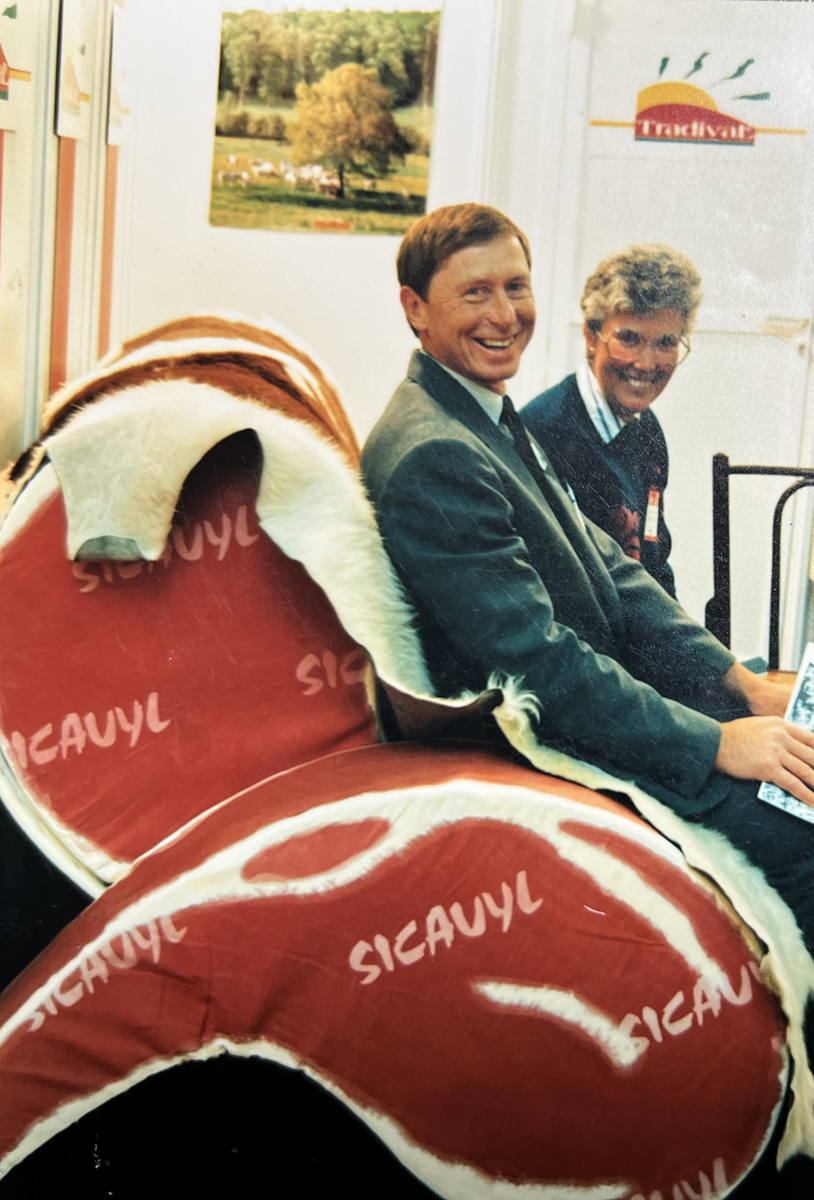 Craig and Penny in European customer office 1990’s
The next decade: automation, 3D vision, and the future of processing
Craig has watched automation evolve from early promise to practical potential. He remembers trialling a robot in Hastings in 1992, a fascinating idea that wasn’t reliable enough to remove the need for a person alongside it. “At eight out of ten, you still have to have the person there beside it,” he says. And for smaller plants, even a perfect robot might only replace part of a role at their scale.
What’s changed is vision technology. Earlier systems relied on two-dimensional imaging. Now, with 3D cameras, Craig sees a turning point: the ability to “pick and place” and follow contours matters because “every lamb is actually an individual, and they’re just not exactly the same.” He expects that leap to help automation finally “come of age.”
Asked what keeps him in the meat industry after decades, Craig’s answer is simple: flux. The sector is shaped by weather, seasons, and shifting global markets. That unpredictability can be a weakness but it’s also a source of energy.
“Our industry is in a continuous state of flux. There’s never a dull moment.” It’s not for everyone but for those who choose it, he adds, “it gets in your blood.”
And for Craig, that’s the point: a career that demands learning, adaptation, and the courage to keep moving, the same spirit that began with an applied science degree at Massey, and became a life’s work.
Legacy: a model worth emulating and a stronger chain from farm to consumer
When Craig thinks about legacy, he doesn’t focus on titles or scale. He focuses on business models and connections.
He hopes to leave “a model that could be considered an exemplar in the industry,” something others might choose to emulate because it creates positive outcomes. He’s also a strong advocate for better links across the supply chain: from farm decisions through processing and export, all the way to understanding consumer demand.
Historically, he says, different parts of the chain could become disconnected, each focused on its own problems without considering impacts elsewhere. Craig believes stronger information flow, commitment programmes, and producer connection create better long-term outcomes and more efficiency for the entire sector.
In other words: progress isn’t just machinery or market reach. It’s the willingness to keep improving, keep connecting, and keep building something that lasts.
And it all started with a study grant Craig almost didn’t apply for and an applied science degree that turned curiosity into a lifelong commitment.